

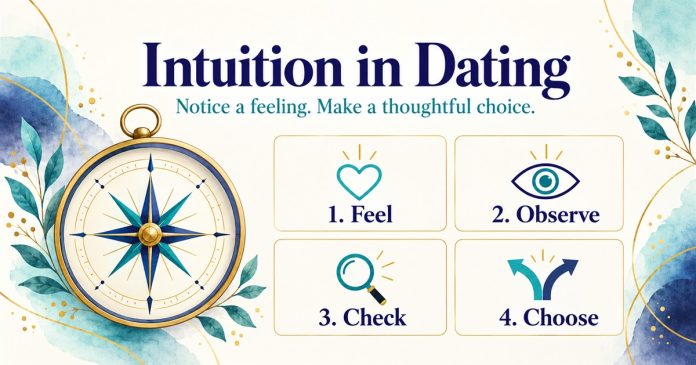
A new message makes you smile, or a date leaves you with an uneasy feeling you cannot yet explain. If you value intuition, those moments may feel like an inner nudge worth hearing. You can listen without requiring the feeling to predict the future or reveal another person’s hidden intentions.
Intuition can begin a question: “What did I notice, and what would help me choose?” It does not have to deliver a final verdict about whether someone is safe, compatible or destined for you.
What intuition can mean in dating
People use intuition for a quick impression that arrives before a full explanation. They may understand it through experience, spirituality or both. A familiar expression, a conversational pattern, attraction or a personal association might contribute to what feels immediate.
Confidence is not a reliable accuracy test. In their review of intuitive expertise, Daniel Kahneman and Gary Klein emphasize the predictability of the setting and opportunities to learn from feedback. That does not make a first date a reliable mind-reading exercise. Treat a hunch as information about your response, alongside what you observe.
Our guide to intuition, experience and thoughtful checks explores that distinction in more detail.
Notice the feeling without assigning a single cause
1. Tension or an urge to leave
Notice what feels uncomfortable. You can leave or decline another meeting without proving the person is bad. A tense body by itself does not explain whether the cause is their behavior, the setting, your own worries or something else.
2. Calm or a sense of familiarity
Comfort can be welcome. Continue to learn about the person rather than using ease as proof that every boundary will be respected. Familiarity and trust are different things.
3. Excitement and attraction
You can enjoy chemistry while choosing your pace. A racing heart does not settle whether a connection is promising or concerning. Ask what else happened during the interaction.
4. Mixed or uncertain feelings
You may like someone and still need more space or information. There is no obligation to make your feelings consistent before setting a limit. You can choose another date, wait or decline.
Check behavior that matters to you
Start with concrete events. Did they listen when you said you were leaving? Did an agreed plan happen? Can you decline a request without being pressured? Do they respect privacy and the pace you choose? These questions are more useful than trying to decide what a wave of cold or a knot in your stomach must mean.
Love is respect’s boundary guidance emphasizes room to express needs and limits without fear. You do not need a spiritual explanation before expecting that respect.
A calm feeling is not a reason to skip ordinary precautions when meeting someone new. Choose a meeting arrangement and transport you can control, tell someone you trust your plan when appropriate and protect private information. If you feel in immediate danger, seek local emergency help rather than trying to interpret the feeling first.

Reflect afterward, with room to revise
Make a short note soon after the interaction if it would help. Record the event, your initial impression and what remains unknown. Later, add what you actually learned, including details that contradict your first interpretation. Avoid rewriting the original hunch to make it seem more accurate.
You do not need to announce that you are testing someone or create secret challenges to provoke a reaction. The purpose is to understand your experience and choices, not to investigate another person through intuition. Respect their privacy too.
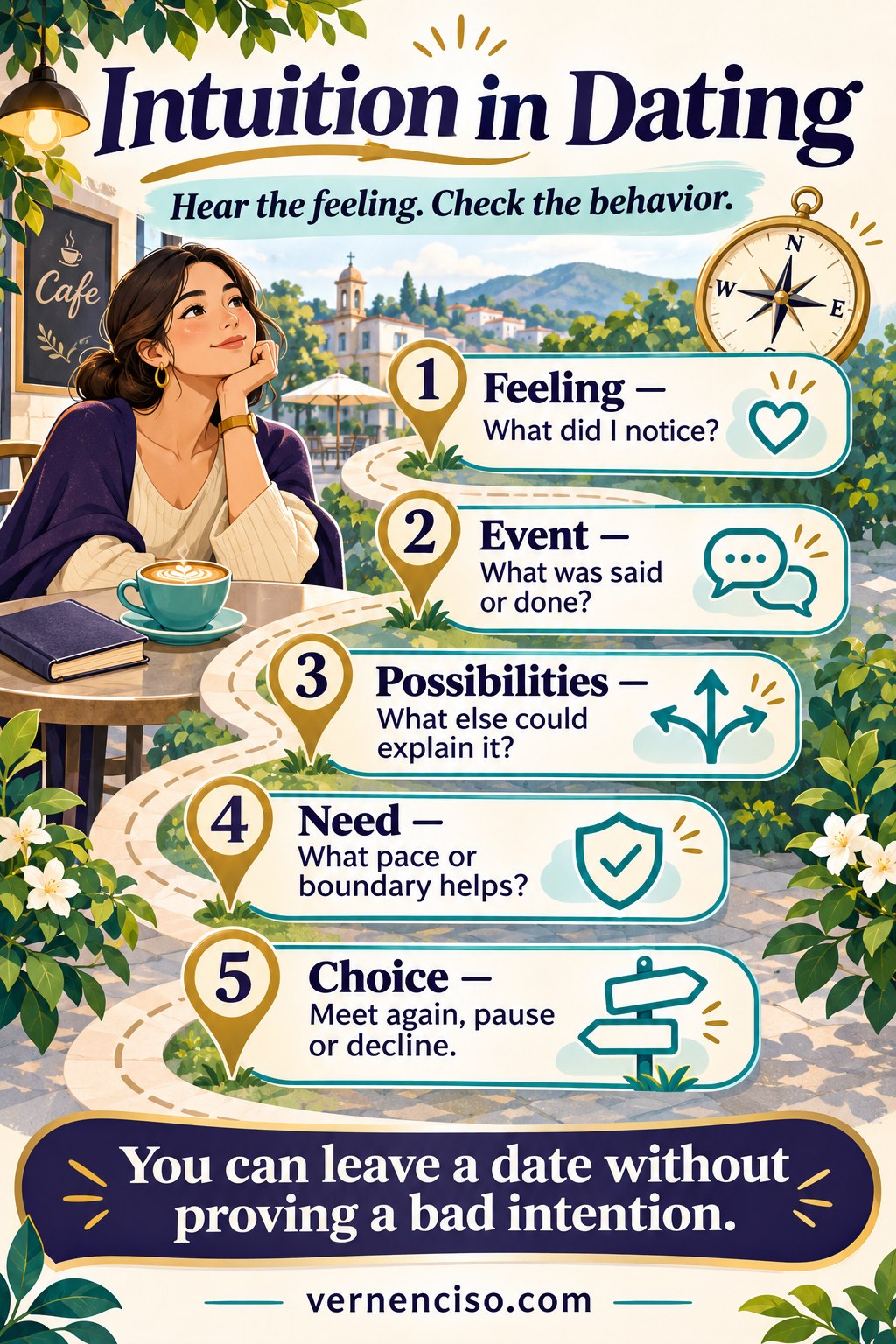
Free feeling-fact-choice dating card
- Feeling: What did I notice emotionally or physically?
- Event: What was actually said or done?
- Other explanations: What else could have contributed to my response?
- Need: What pace, information or boundary would help me?
- Choice: Do I want another meeting, more time or no further contact?
Example: “I felt rushed. They asked to move to a private place after I said I wanted to stay in the café. I want to leave.” You can act on that boundary without proving what they intended. In a different situation, nervousness before a welcome date may simply lead you to choose a shorter meeting.
Learn from earlier relationships without blaming yourself
Looking back can reveal preferences or patterns you want to change. It can also make an earlier event seem more obvious than it was at the time. Ask what you knew then, what you learned later and what support would be useful now.
If someone mistreated you, missing or dismissing a feeling did not make you responsible for their behavior. Our guide to repeating relationship patterns leaves room for choice without assigning blame.
You can practice noticing preferences in low-stakes situations, such as choosing which book to read or whether you want a quiet evening. Record what you expected and what you enjoyed. That practice does not certify your intuition for major decisions about health, housing, work or other people.
Let spiritual meaning support your freedom
A card, prayer or reflective pause can help you hear your own wishes. It cannot establish that a stranger is your soulmate or that someone who declined contact secretly wants a relationship. For that larger question, read soulmates and everyday compatibility.
You are allowed to be curious, change your mind and make an imperfect choice. A useful intuition practice keeps space for new information and a clear no. It does not require you to trust every feeling or remain in a situation that you do not want.
Frequently asked questions
1. Can intuition help me decide whether to date someone?
It can draw attention to a feeling or a question. Combine it with observed behavior, your preferences and boundaries rather than treating it as a prediction.
2. Does feeling calm prove someone is safe?
No. Comfort can matter to you, but it does not establish another person’s intentions or future behavior.
3. Do butterflies mean love or danger?
Neither conclusion follows from that sensation alone. Notice the setting and actual interaction, and choose a pace that suits you.
4. Can I leave a date without knowing why I feel uneasy?
Yes. You do not owe another meeting or a detailed justification. Use the safest practical way to leave or seek help if needed.
5. What if my first impression was wrong?
You can revise it. Being mistaken does not mean your ability to make choices is broken.
6. Should I test my date to see how they react?
Avoid secret traps or provoking a reaction. Observe ordinary interactions, respect privacy and set boundaries directly when it is safe.
7. How do I keep an intuition journal?
Record the original impression, the event, uncertainty and later information. Include contradictions and misses rather than only apparent matches.
8. Can tarot reveal my date’s private feelings?
A reading does not establish what someone privately thinks or whether they consent. Ask and respect the answer they choose to give.
9. What if a feeling reminds me of an ex?
Consider both the present behavior and the personal association. Familiarity alone does not show that two people will behave the same way.
10. Did ignoring my gut cause past mistreatment?
No. Another person remains responsible for their behavior. You deserve support without having to prove you noticed every warning.
11. Should I tell everyone about my private reflections?
You can choose what to share. Protect other people’s private information and seek trusted support when it would help.
12. Can a soulmate feeling replace getting to know someone?
No. A meaningful feeling can coexist with ordinary questions about compatibility, consent, values and how you treat each other.
13. Can I practice intuition outside dating?
You can notice low-stakes preferences and compare them with later experience. That does not establish reliable judgment in high-stakes situations.
14. What if I never get a clear gut feeling?
You can make choices through information, preferences and conversation. A dramatic inner signal is not required.
15. Do I have to agree to another date to be fair?
No. Continuing contact should be a freely chosen decision for both people, not an obligation to overcome uncertainty.