


Deep connection / everyday compatibility
Feeling that you have found your soulmate can be deeply meaningful. It is not, on its own, a way to know whether a relationship will work. You may understand soulmate as a spiritual bond, a lifelong companion or someone with whom you feel unusually at home. There is room for that meaning alongside questions about care, consent and the life you want to share.
You do not have to choose between romance and paying attention. Let the feeling be part of the picture while you continue to learn about each other. The areas below are prompts for reflection, not a score, a diagnosis or a test that proves somebody is “the one.”
On this page
Seven areas that make the feeling worth exploring
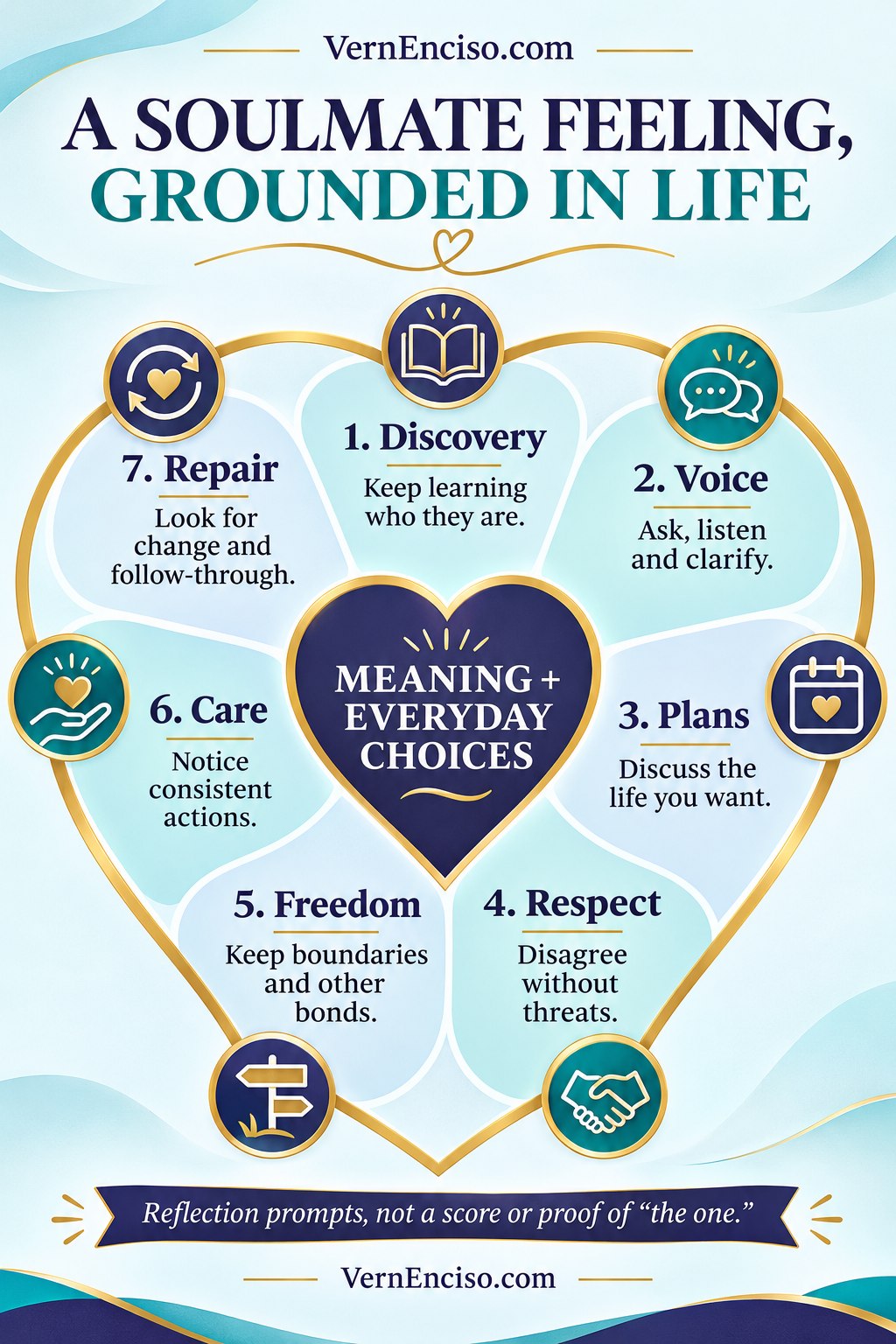
1. Recognition leaves room for discovery
You may “just know,” feel you have met before or experience powerful chemistry. You can value that without assuming you already know the person’s character, intentions or past.
Notice: Are you willing to update your impression when new information arrives? A spiritual interpretation of familiarity is not proof of a shared past life or of someone else’s consent.
2. Ease includes being able to speak
Comfortable silence can be lovely. So can knowing a familiar expression. Neither establishes an attachment style, telepathy or an ability to understand everything without words.
Notice: Can you ask what the other person means, explain a need and correct a misunderstanding? Feeling understood should not require either of you to guess perfectly.
3. Important plans can be discussed honestly
Consider the practical questions that matter to you: children, money, home, faith, care responsibilities, exclusivity or the kind of commitment you want. Not every difference has a workable compromise.
Notice: Can you describe a difference without disguising it to preserve the soulmate story? You may enjoy different hobbies and still want a compatible shared life.
4. Disagreement does not remove respect
Being able to talk is useful, but no couple can work out every issue simply by finding better words. Listen for a specific concern rather than a verdict about someone’s worth.
Notice: Can both people speak, pause and return without mockery, threats or pressure? Respect matters even when you decide that you cannot agree.
5. Closeness leaves room for choice
Time together need not mean giving up friendships, privacy, rest or individual interests. Jealousy is a feeling to address, not permission to monitor or restrict someone.
Notice: Is affection freely offered, and can either person decline contact or a request? You should not have to prove devotion by surrendering your choices.
6. Apologies connect to action
An apology, a gentle check-in or a wish to start again may open a conversation. The words matter more when they are followed by responsibility and a change you can actually describe.
Notice: Does the same harm keep returning while you are expected to forgive quickly? You are not responsible for making another person accept repair.
7. Commitment is chosen, not owed
“You complete me” may express gratitude for mutual support. It need not mean that either person is incomplete alone, and needing help does not make a bond less worthy.
Notice: Would you freely choose the relationship as it is, not only as you hope it could become? A meaningful bond can support your agency rather than make leaving unthinkable.
Love can change shape without following a fixed timetable
Early attraction, the practical work of sharing a life and a more deliberate sense of partnership can each feel different. They are useful experiences to reflect on, not three stages every couple must pass through in the same order.
1. Excitement and discovery
Newness may make a connection feel extraordinary. Enjoy what is welcome while learning how the person handles ordinary plans, differences and your boundaries. Intensity cannot establish that you have found your only possible partner.
2. Everyday responsibilities
Work, care duties and household planning can take up space that romance once occupied. Ask what support or time together you both want. A quieter period does not automatically mean the love was false, and practical strain does not excuse harm.
3. Chosen connection
You may find meaning in small acts of care, honest repair and plans both people want. This kind of closeness can be built and renewed, but one person’s effort cannot create mutual commitment on its own.
The Gottman Institute’s discussion of soulmates offers one perspective on building a relationship rather than relying only on the feeling of destiny. It is not a requirement to stay with a particular person. You can decide that an important difference or an unmet need makes the relationship wrong for you.
Free soulmate reflection card
Keep the spiritual meaning and the everyday evidence side by side:
- Meaning: What does soulmate mean to me, in my own words?
- Reality: What recent behavior makes me feel cared for or concerned?
- Mutuality: What do we each actually want, without guessing?
- Choice: What question, boundary or next step would help me now?
If you are single, use the same card to name the relationship you would like to build. You are already a whole person. There is no deadline, compulsory search or promise that one exact person must appear for your life to be meaningful.
Useful research is not a forecast for your relationship
A 2020 study combining 43 longitudinal couples datasets found that people’s reports about their relationship—such as perceived partner commitment, appreciation and conflict—were useful predictors of reported relationship quality. Changes in relationship quality over time were largely unpredictable from the self-report measures examined. That is a reason to take everyday experience seriously, not to turn a few signs into a guarantee.
The Gottman Institute describes criticism, contempt, defensiveness and stonewalling as concerning communication patterns in its work with couples. For your own reflection, a useful distinction is between raising a specific problem and repeatedly humiliating someone. One expression or argument is not an individual divorce prediction.
You can believe that a meeting was meaningful and still expect a relationship to need attention. Conversely, “relationships take work” is not a reason to accept harm or keep investing in a future the other person does not want. Neither destiny nor effort decides the choice for you.
The “other half” story is one story—not a requirement
In Plato’s Symposium, the character Aristophanes tells a myth about original humans being divided by Zeus and longing for reunion. It is a story within a philosophical dialogue, not evidence that every person has one missing half. It also does not explain every religious or spiritual understanding of soulmates.
You may prefer to think of a soulmate as recognition, companionship or shared growth. If you interpret dreams or familiarity through past lives, our guide to past-life regression and false memories discusses why an experience that feels vivid is not automatically a verified history.
A four-part conversation, if it is safe and welcome
Try a conversation rather than a secret compatibility test. You can choose your own words, pause it or decide not to have it. If you fear someone’s reaction, use the safety guidance below instead of rehearsing a confrontation.
- Say what feels meaningful. “I feel close to you, and I enjoy the way we make time for each other.” Name an experience rather than asking the other person to confirm a cosmic certainty.
- Ask about one practical need. Choose something relevant, such as how you make plans or what commitment means to each of you. Make space for an answer you did not expect.
- Discuss a workable next action. If both people want to continue, agree on something specific. An apology or promise need not settle every concern immediately.
- Keep the choice open. Notice what happens after the conversation. You may continue, ask for suitable individual support or decide the relationship is not right for you. No fixed waiting period is required.
An imagined everyday example
Suppose you feel a soulful connection but want different amounts of time together. You might say: “I love our evenings together, and I also need an evening for my friends. What would a workable week look like for both of us?”
The aim is not to obtain a perfect answer. It is to learn whether both people can speak and choose without pressure. This is an ordinary planning example, not a method for testing someone who frightens you.
When the soulmate feeling comes with pressure
Grand gestures or early excitement do not, by themselves, identify abuse. Concern grows when affection is tied to pressure, isolation or disregard for your choices. Cleveland Clinic’s explanation of love-bombing describes this controlling pattern. You do not need to infer someone’s motives or deliberately provoke a reaction to ask for help.
Safety does not depend on the label
If you face threats, sexual coercion, monitoring, isolation or control of money, seek support suited to your circumstances. You do not have to confront the person or leave immediately to deserve help. The National Domestic Violence Hotline explains personalised safety planning while experiencing abuse, preparing to leave or after separation.
In the United States, call 1-800-799-7233 or text START to 88788; message and data rates may apply. If your internet use may be monitored, consider a safer device. Outside the U.S., contact a local specialist service. In immediate danger, contact local emergency services.
Explore the part of the question that matters to you
For the feeling itself, see Knowing How You Found the One and They Really Do Love You. For everyday fit, explore signs you are compatible or why you fall for the same types.
If spiritual language is making a bond feel compulsory, our guides to karmic relationships and breaking free from soul contracts focus on meaning without obligation. Divorce and breakups considers choices when a relationship ends. None of these labels removes your right to decide what contact you want.
20 questions about soulmates and compatibility
1. Does everyone have a soulmate?
People understand soulmate differently: one destined partner, several meaningful bonds or a name for deep closeness. There is no reliable test that can establish which belief is true for you. Not having a partner does not mean you are incomplete or have missed your only chance.
2. How do I know if someone is my soulmate?
Decide what the word means to you, then look at the relationship itself. Consider whether care is mutual, your choices are respected, important plans can be discussed and problems lead to meaningful action. Those questions can inform a choice; they cannot certify destiny or guarantee lasting love.
3. What if I felt it instantly?
An immediate connection can be exciting and meaningful. Enjoy it at a pace you freely choose while continuing to learn about the person. You do not need to dismiss the feeling, make a major commitment immediately or wait a prescribed year before describing it.
4. Is believing in soulmates harmful?
The belief itself does not tell us whether your relationship is healthy. It becomes concerning if it excuses mistreatment, removes your freedom to leave or makes ordinary differences feel like proof of failure. A sense of spiritual connection and a willingness to learn can exist together.
5. Can a soulmate relationship be difficult?
A meaningful relationship can include differences, practical strain or hurt feelings. Difficulty is not automatically a spiritual lesson or proof that you should stay. Consider how each person responds, whether change is possible and whether you feel safe and free to choose.
6. What is a twin flame, and is it different?
People use twin flame for an especially intense spiritual connection, sometimes described as mirroring or sharing a soul. Definitions vary. Neither this label nor soulmate establishes another person’s wishes, requires pursuing someone who has declined contact or obliges you to accept harm.
7. Can my soulmate be a friend rather than a partner?
Yes, if that is how you use the word. Soulmate can describe a deeply meaningful friendship or another non-romantic bond. Mutual care and respect still matter; the label does not turn friendship into romantic consent.
8. What if my partner does not feel like a soulmate?
Not using the label does not automatically make the relationship wrong. Equally, you do not have to stay just because someone is kind or a checklist looks reassuring. Consider whether you want this relationship, whether important needs are met and whether both people can discuss uncertainty.
9. Can you have more than one soulmate in a lifetime?
Some people believe so, while others reserve the word for one connection. Deep love after loss or separation need not erase an earlier bond. You can choose language that honours your experience without treating it as proof of a universal spiritual rule.
10. Why do I feel like I have known them before?
Shared experiences, familiar mannerisms or attraction may contribute, and you may also give the feeling a spiritual interpretation. The feeling alone cannot establish a past-life history or what the person wants now. Keep learning about them and checking assumptions through ordinary conversation.
11. Is it a bad sign if we argue?
Disagreement alone does not decide the quality of a relationship, and couples express differences in different ways. Look at whether concerns can be heard without humiliation, threats or pressure. A pause and a later conversation may help ordinary conflict; fear or coercion calls for specialist support.
12. What is the biggest predictor of a relationship failing?
There is no single sign that reliably forecasts every couple’s future. Repeated contempt or humiliation deserves attention, but a research association is not an individual divorce prediction. Threats or abuse need support regardless of where any behaviour ranks on a list.
13. Should I wait for my soulmate rather than settle?
You do not have to accept a relationship you do not want, or hold out for a particular dramatic feeling. Clarify the care, attraction, values and future you want. Choosing freely matters more than proving that a person is perfect or that you have lowered your standards.
14. Can a psychic tell me who my soulmate is?
A reading may offer a perspective on your hopes or choices, but it cannot reliably verify a future partner’s identity, another person’s consent or a guaranteed romantic outcome. Be cautious of certainty, pressure to pursue a specific person or repeated payments to secure or release a bond.
15. What is love-bombing and how is it different from a soulmate connection?
Love-bombing describes intense attention or affection used in a controlling or manipulative pattern. Excitement or a generous gesture alone does not establish it. Pay attention to pressure, isolation and disregard for your choices. Do not deliberately test a person you fear; seek suitable support.
16. We complete each other. Is that healthy?
The phrase may simply describe mutual support or complementary strengths. Needing practical help, including because of disability or illness, does not make love unhealthy. Consider whether support respects each person’s agency, rather than using need to justify control or prevent independent choices.
17. Do soulmates share the same interests?
They do not have to. Shared interests can be enjoyable, but people can also value different hobbies and time apart. Discuss how you want to share time and how important values or future plans fit; no particular amount of overlap proves a soulmate bond.
18. How long before I can tell?
There is no universal deadline. Getting to know someone across everyday situations can give you more information, but it does not produce certainty. Take the time you need for a particular commitment, and do not wait for a milestone before responding to pressure, incompatibility or safety concerns.
19. What if I have never felt the soulmate feeling?
You are not failing at love. Connection may feel gradual, steady, intense or difficult to label, and not everyone wants a romantic relationship. You can explore what closeness means to you without forcing a lightning-strike experience or ranking one style of attraction above another.
20. What is the one thing to look for?
Start with whether both people can be themselves and make choices without fear. Then consider care, attraction, communication and the practical life you want. No single sign replaces the fuller picture, and you do not need a complete assessment before taking a serious concern seriously.
A deep connection can be part of your spiritual life and still leave room for ordinary questions. Let meaning, mutual care and freely chosen action belong in the same conversation.
The suggestion that soulmates can push us beyond our comfort zones for personal growth is quite thought-provoking. It implies a dynamic rather than a static relationship, which can be both challenging and rewarding.
The concept of soulmates is intriguing, particularly the idea that they might not align with our initial expectations. It suggests a deeper, perhaps more spiritually grounded connection that goes beyond superficial qualities.
The notion that soulmates can appear in disguise and that initial impressions might be misleading is a fascinating one. It challenges the conventional wisdom of love at first sight and emphasizes deeper connections.
The list of soulmate characteristics provided is comprehensive and covers many aspects of a deep relationship. It’s worth reflecting on how these traits manifest in different relationships and what it truly means to ‘complete’ one another.
While the idea of soulmates sharing life goals and values is appealing, it’s interesting to consider how much these aspects need to align for a relationship to be considered a ‘soulmate’ connection.