

Quick guide
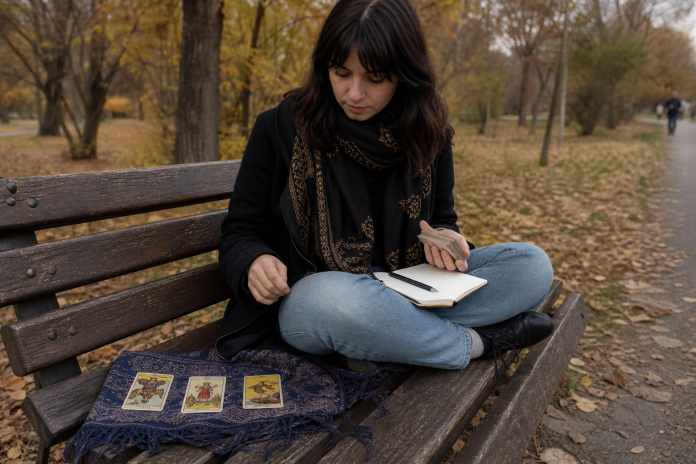
A tarot spread is a layout in which each position asks a question: what is behind this, what is in front of me, what am I not seeing. The cards are prompts; the position is what turns a prompt into a thought. That is the whole method, and it is why tarot works well as structured reflection and not at all as prediction: no spread has ever foretold an event under controlled conditions, and a “future” position is best read as “where this is heading if nothing changes”. Beginners do best with one and three-card spreads for a month before adding positions. Below are thirteen spreads that cover a day, a week, a decision, a relationship, a career question, self-care and shadow work, with the positions, the question each position asks, a worked example, and a method for reading that keeps you honest.
How a spread works
- 1. Ask one real question“What do I need to see about this job offer?” beats “Will I get the job?” Reflection questions give the cards something to do; prediction questions give them nothing.
- 2. Shuffle and layAny shuffle. Lay the cards face down in the positions, then turn them one at a time. Read each card’s image before its book meaning: what is the figure doing, what is the mood?
- 3. Read card and position togetherThe Tower in “what is behind this” reads as a past upheaval; in “what I am avoiding” it reads as a change you will not face. Position changes meaning.
- 4. Write it down and actOne line per card, one line for the whole, and one thing you will do. Come back in a month; the notebook is where you learn whether the reading was insight or mood.
The thirteen spreads
| Spread | Cards | Positions and the question each asks | Best for |
|---|---|---|---|
| 1. Daily card | 1 | What do I need to keep in mind today? | Building the habit; learning the deck |
| 2. Past, present, direction | 3 | What led here; what is true now; where this heads if nothing changes | Any situation you keep circling |
| 3. Mind, body, heart | 3 | What is occupying my thinking; what my body needs; what I am feeling and not saying | A weekly check-in |
| 4. Week ahead | 3 or 7 | Start, middle and end of the week; or one per day: what to attend to | Planning; noticing patterns over a month |
| 5. Four elements | 4 | Earth: practical and money; Air: thinking and communication; Fire: action and drive; Water: feeling and relationships | A wide check on life balance |
| 6. Problem, response, outcome | 3 | What is the actual problem; what response is open to me; what that response likely leads to | Feeling stuck |
| 7. Relationship | 5 | What I bring; what they bring; what the relationship is now; what strains it; what would help | Any relationship, romantic or not; read your side, not their mind |
| 8. Two options | 5 | The situation; option A and what it asks of me; option B and what it asks of me; what I am not considering | A decision between two paths |
| 9. Career | 5 | Where I am; a strength I underuse; an obstacle; an opening I have not noticed; the next step | Work questions, job changes |
| 10. Self-care | 5 | What blocks my care for myself; what to release; how to nurture myself; a strength to lean on; how confidence grows | Low patches, after burnout |
| 11. Goal | 5 | The goal in one image; my real motivation; the obstacle; the resource I already have; the first action | Turning a wish into a plan |
| 12. Month ahead | 5 | One per week plus one for the month’s theme | Planning; pairs well with a journal |
| 13. Shadow | 5 | What part of me is surfacing; why now; how to work with it; a strength that helps; what integration looks like | Self-knowledge; see Beginning Shadow Work |
Three worked examples
| Spread and question | Cards drawn | A reading | The action |
|---|---|---|---|
| Past, present, direction: “What do I need to see about my friendship with M?” | Five of Cups, Knight of Swords, Two of Cups | Behind it: a disappointment I have not let go. Now: I am ready to say something, perhaps too sharply. Direction: if I speak with care, the bond holds. | Message M, name the thing, no accusation. |
| Problem, response, outcome: “Why can’t I start the course?” | Nine of Swords, Ace of Cups, The Star | Problem: dread at night, not lack of time. Response: let the feeling be there and be kind about it. Outcome: hope returns once the first lesson is done. | Book lesson one for a morning, not an evening. |
| Two options: “Stay in the flat or move?” | Two of Pentacles, Ten of Wands, Six of Swords, The Hermit | Situation: juggling. Staying asks me to carry a heavy load a while longer. Moving asks me to leave something behind and travel light. Not considering: I have not sat alone with this; every opinion is someone else’s. | A weekend with no advice from anyone, then decide. |
Reading without fooling yourself
Key takeaways
- The card is a prompt; the meaning is yours. Two readers with the same card will say different true things. That is not a flaw; it is what reflection tools do.
- Read the picture first, the book second. Your reaction to a figure walking away from spilled cups is more useful than a memorised keyword.
- “Future” means trajectory. A card in a future position describes where things go if nothing changes, which is precisely the information that lets you change something.
- Do not re-draw for a better answer. One spread per question per day. Re-drawing turns reflection into fishing.
- Do not read other people’s minds. In a relationship spread, the “what they bring” card is your perception of them, not their inner life. Say so in the notebook.
- Keep the journal. After a month you will know which spreads help you think and which just soothe. Both are fine; knowing the difference matters.
- Tarot is not for medical, legal or financial questions. Use it to think about how you feel about those; use professionals for the questions themselves.
Choosing a deck and a first month
Any deck with fully illustrated pip cards makes learning easier; the classic 1909 Rider-Waite-Smith deck, which is in the public domain and printed by many publishers, is the one most books describe. Spend the first month on the daily card and the three-card spreads only. Draw, look, write one line, and at the end of the month reread the notebook: you will have learned more about your own patterns than any book could teach, and you will have learned the deck by use rather than memorisation. If you want a reading from someone else, tarot readers vary widely; the guide to getting something useful from one, and what to walk away from, is in Talking to a Psychic About the Future.
Related reading
- Talking to a Psychic About the Future: decision questions instead of prediction questions.
- How a Psychic Reads You: what happens at the table.
- The Language of Psychic Symbols: why images work as prompts.
- Nine Tips to Increase Your Intuition: the hunch log, which pairs with a tarot journal.
- Rituals for Moving On: using a spread to name an ending.
Frequently asked questions
1. What is a tarot spread?
A layout of cards in which each position asks a particular question about your situation. The card drawn into a position is read in the light of that question, which is what makes a spread more useful than a single card pulled at random.
2. Which spread should a complete beginner start with?
The daily single card for two weeks, then the three-card past, present, direction spread. Both teach the deck and the habit of reading a card in context without overwhelming you with positions.
3. Can tarot predict the future?
No. There is no evidence that any card layout foretells events, and no reader has demonstrated it under controlled conditions. Tarot is a structured way of thinking about your situation, and read that way it is useful.
4. Then what does a “future” card mean?
The direction things are heading if nothing changes, as you sense it now. It is the most useful card in the spread precisely because you can act on it.
5. How should I phrase a question?
Open, about yourself, and about seeing rather than knowing: “What do I need to understand about this?” “What am I avoiding?” Avoid yes-no questions, questions about other people’s thoughts, and anything with a date in it.
6. Do I need to memorise all 78 cards?
No. Read the picture and the position first, and look up the traditional meaning afterwards. Within a couple of months of daily draws you will know the deck without having sat down to learn it.
7. What if I draw a frightening card?
Death, the Tower, the Devil and the Ten of Swords frighten beginners and mean, respectively, an ending, a sudden change, a bond that binds, and a low point that is over. Read them as prompts about what is ending or changing, not as threats.
8. What about reversed cards?
Optional. Many readers ignore reversals entirely; others read them as the card’s energy blocked, delayed or turned inward. Start without them and add them if you find they help you think.
9. Can I read for other people?
Yes, as a conversation: lay the cards, describe the images, and let them do the interpreting. Never claim to see their future or their health, and never read for someone who has not asked.
10. Is it bad to do several spreads a day?
One per question per day is the sensible rule. Repeating a spread until you get an answer you like is how tarot stops being reflection and becomes a way of avoiding a decision.
11. Which deck should I buy?
One whose pictures you like and whose minor cards are fully illustrated. The Rider-Waite-Smith deck of 1909 is the one most guides are written around and is inexpensive; many modern decks follow its structure with different art.
12. Do I have to believe in anything for tarot to work?
No. As a reflection tool it works for sceptics, because the work is done by the questions and by you. Belief is optional and changes nothing about the method.
13. Can tarot help with anxiety?
A daily card and a written line can be a calming ritual, and naming a worry in a spread can shrink it. Tarot is not treatment for an anxiety condition; if worry is constant, see a GP alongside the cards.
14. Should I keep a tarot journal?
Yes; it is the single thing that turns tarot from entertainment into self-knowledge. Date, question, cards, one line each, one action. Reread monthly.
15. What is the relationship spread actually reading?
Your perception of the relationship, including your perception of the other person. It cannot read their mind. Used that way, it is a good way to see your own assumptions laid out.
16. Is there a right way to shuffle or cleanse a deck?
Shuffle however you like. Cleansing rituals (knocking, salt, moonlight) are a way of marking the start of a session; they change nothing about the cards. Do one if it helps you settle.
17. Can I use tarot for medical, legal or money decisions?
Use it to explore how you feel about them. For the decisions themselves, use a doctor, a lawyer or an adviser. A reader who offers medical or financial predictions is one to leave.
18. What is the best thing to do tonight?
Draw one card, look at it for a full minute before reading anything about it, and write one sentence about what it brings to mind. That is the practice.
Evidence note: this article presents tarot as structured reflection and states plainly that no spread predicts events. Language in the earlier version about magic working through the cards and about layouts revealed by the spiritual world has been removed, and “future” positions are reframed as trajectory. Tarot is not a substitute for medical, legal or financial advice, or for treatment of anxiety or low mood; in the US, 988 is the crisis line by call or text.
This article seems like it’s trying to sell a magical solution to life’s problems through tarot, but let’s be real—can pulling a card really offer profound insights into your life? I remain skeptical. While it may be a fun exercise in self-reflection, attributing deep spiritual significance to random card arrangements feels like stretching reality a bit too far. Tarot can be entertaining, but I wouldn’t rely on it for serious decision-making.
While skepticism is healthy, don’t underestimate the power of symbolism and intuition that tarot can tap into.
I agree with your skepticism. Perhaps the allure of tarot lies more in its narrative potential rather than actual divination capabilities.
This article is quite enlightening! It beautifully illustrates how tarot can be used as a tool for introspection and self-discovery. Each spread offers a unique perspective on different aspects of life, encouraging readers to explore their inner world with curiosity and openness. The suggested layouts are practical and easily accessible for beginners, making it an excellent starting point for those interested in developing their intuitive skills. Tarot isn’t just about predicting the future; it’s about understanding yourself better.
I couldn’t agree more! Tarot has been instrumental in helping me navigate my emotions and make sense of my experiences.
@EnlightenedAlice Absolutely! It’s all about the journey within rather than looking outside for answers.
“Spiritual connections,” “unique layouts,” “inner selves”—a fascinating cocktail of concepts wrapped up in mystical allure! As someone who appreciates both science and spirituality, I find this blend intriguing yet perplexing. The emphasis on personal growth through structured spreads provides a logical framework while inviting introspection—a duality that’s both comforting and challenging to navigate. However, caution should be exercised not to lose oneself entirely in metaphysical wanderings; balance is key.
“Weekly Snapshot Spread,” “Mind-Body-Spirit Spread”… Sounds like we’re planning a strategic board meeting rather than engaging with ancient divination practices! While I appreciate the modern approach to tarot outlined here, I can’t help but chuckle at how structured it’s become. Perhaps there’s merit in keeping some mystery alive—after all, isn’t that part of what makes tarot so fascinating? Still, kudos to whoever manages to plan their week around these spreads!