
A personal pause / six gentle steps
Using your hands to “recharge” can be a quiet way to give yourself care and attention. You might experience the practice as spiritual renewal, a moment of prayer or simply a comfortable pause. Light self-touch, an easy breath and an optional image of warmth can belong in the same routine without requiring you to prove an energy transfer.
The six steps below are invitations, not a prescription. You do not need to feel tingling, see light or become calm for the pause to count. Adapt or skip anything uncomfortable, and do not use the routine to explain away persistent tiredness or other symptoms. For the wider context of Reiki and practitioner-led sessions, see Understanding Energy Healing.
On this page
Start with comfort, not a target sensation
Choose a place where you can sit with support or lie comfortably. There is no required room, candle, crystal or special clothing. Keep your eyes open if that feels better. Give yourself permission to stop rather than treating stillness as a test of willpower.
You remain in charge of the practice
Self-touch is optional, including touch to the chest, belly or forehead. Rest your hands on your thighs or a cushion instead if you prefer. Skip rubbing or movement that irritates your skin or hurts your hands. If focusing inward makes you more anxious or unsettled, stop and look around the room; you can choose a different activity or ask for support.
A gentle six-step hands-on routine
Allow a few minutes if you wish, rather than forcing a ten- or fifteen-minute session. A longer pause is not automatically more helpful. Your own care instructions take priority over a general exercise.
- Settle and let the breath be easy. Find a supported position. Notice the contact of the seat, bed or floor. Let your breathing stay gentle and unforced; you do not need a deep breath, a long exhale or a breath hold. The NHS breathing guide offers a separate, fuller breathing exercise if you want one.
- Choose a beginning gesture. Bring your palms together loosely if comfortable. You may briefly touch your forehead and then your chest, or simply rest your hands in your lap. If the heart and third-eye centres are meaningful in your practice, let the gesture express that intention; it is not a required activation sequence.
- Warm your palms gently, if you like. Rub them lightly for a few moments, then stop. Brisk friction, strong heat and a set number of seconds are unnecessary. If rubbing is uncomfortable, leave it out. Neither warm nor cool hands tell you how much spiritual energy you have.
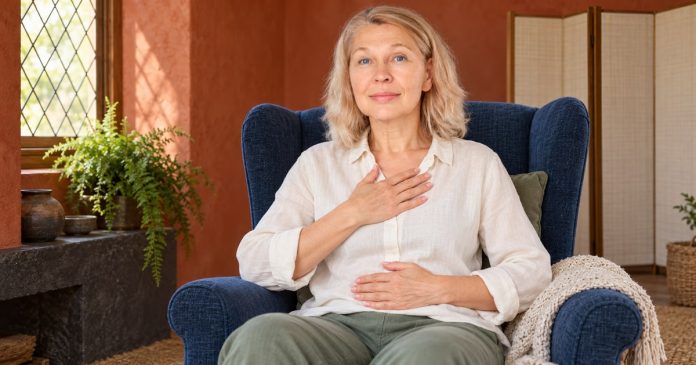
- Let your hands rest somewhere welcome. One palm may rest lightly over clothing on your upper chest and the other on your belly. Either hand can go in either position. Do not press or massage. Hands on the thighs, forearms or a cushion are equally valid choices for this pause.
- Choose one gentle focus. Notice the contact of your hands, a sound in the room or an ordinary object nearby. If you enjoy imagery, picture a soft light or a comfortable scene. You can add a brief prayer or intention such as “May I meet this moment with care.” Return gently when attention wanders; no image or unusual sensation is necessary.
- Finish at your own pace. Let your hands relax and notice the room again. Move or stretch only if comfortable, and rise when you feel ready rather than springing up. Drink water if you want it and it fits your usual care guidance; water is not needed to complete an energy-clearing process. Choose one ordinary next action, such as resting or putting a task aside.
What the parts can mean—and what not to assume
You can value a spiritual interpretation without making each sensation into a measurement. These distinctions keep the practice flexible.
1. An easy breath
Possible meaning: making space to receive or reconnect.
Practical limit: breathing exercises may help some people with stress, but one breath pattern is not compulsory and a calmer moment does not establish an energy change.
2. A beginning gesture
Possible meaning: bringing attention to the heart or intuition.
Practical limit: a familiar gesture can mark your intention. It does not reliably remove anxiety for everyone, and forgetting the sequence does not spoil the pause.
3. Light self-touch
Possible meaning: offering yourself kindness or spiritual care.
Practical limit: notice whether contact is welcome rather than assuming pressure must help. For a broader discussion, read Healing Through Touch.
4. An image or intention
Possible meaning: imagining renewal, light or release.
Practical limit: an image can be personally meaningful without proving that an aura has changed. Not visualising clearly is not a spiritual failure.
5. A clear ending
Possible meaning: carrying care into the next part of the day.
Practical limit: stretching or having a drink is optional. Neither is a test of whether stale energy has left your body.
The National Center for Complementary and Integrative Health describes breathing exercises and guided imagery as relaxation approaches, with evidence that varies by technique and purpose. That does not establish this exact six-step combination as a treatment or show that combining every part works better than choosing one. Notice what is comfortable and useful to you without turning a personal response into a guaranteed mechanism.
Make the pause fit you
1. If touch is unwelcome
Leave your hands supported on a cushion or chair arms. Pay attention to a colour or sound instead. You do not need to explain or overcome your preference.
2. If inward focus feels unsettling
Keep your eyes open and notice the room. Choose an ordinary activity if that feels better. The grounding guide offers other ways to focus on your surroundings.
3. If you want spiritual meaning
Choose your own prayer, blessing or image. You can use it without claiming that the routine measures chakras, removes illness or proves a psychic ability.
4. If nothing changes
End without blaming yourself. Ask whether you need sleep, a meal, fewer demands, companionship or professional care instead of repeating the exercise until you obtain a particular feeling.
An imagined everyday example
After a busy afternoon, someone sits in a supported chair, leaves both hands on a cushion and notices the daylight through the window. They decide not to visualise anything. At the end they still feel tired, so they postpone a non-urgent task and rest. The pause has not diagnosed or cured the tiredness; it has made room for a practical choice.
When a pause is not enough
Persistent tiredness deserves attention
If tiredness lasts for a few weeks without a clear reason, affects daily life or comes with other symptoms, arrange a healthcare assessment. The NHS fatigue guidance explains that causes vary and tests may be needed. A blood test does not identify every cause, and improvement during a ritual does not rule out a health problem.
Seek qualified support for persistent low mood, anxiety or distress too; you do not need to wait for the routine to fail repeatedly. If you need immediate emotional support in the United States, call or text 988. Outside the U.S., use a local crisis service; in immediate danger, contact local emergency services.
Let renewal include ordinary care
You may keep the spiritual meaning of placing your hands with kindness while staying curious about what you actually need. A pause can end in prayer, rest, a boundary or a request for help. None requires you to manufacture a special sensation.
If you are considering a session with someone else, Understanding Energy Healing covers the wider practice, consent, research limits and choosing a practitioner.
The idea of balancing physical and spiritual well-being is interesting. I appreciate the practical steps provided.
The symptoms of low spiritual energy are relatable. It’s helpful to have a structured way to address them.
I agree, structured guidance can provide a path forward when feeling overwhelmed.
Yes, having a clear method to follow can make a significant difference for those feeling lost.
The overlap between physical and spiritual health is intriguing. Further exploration of this interplay could be quite enlightening.
Indeed. Understanding how these dimensions of health influence each other is critical.
Absolutely. Comprehensive studies would help in validating and expanding on these concepts.
The connection between spiritual energy and overall health is a fascinating concept. It’s an area often overlooked.
I agree, integrating both aspects seems essential for holistic health.
The exercise described for restoring spiritual energy seems simple yet effective. It would be interesting to see scientific studies on its impact.