

Quick guide
“Energy healing” is an umbrella for practices such as Reiki, Therapeutic Touch, Healing Touch, qigong healing and pranic healing, in which a practitioner places their hands on or just above a clothed person with the intention of helping them heal. A session is quiet, gentle and, by every study so far, safe. What the research does not support is the mechanism: no energy field has ever been detected, practitioners tested under blind conditions could not sense one, and trials of Reiki for pain, anxiety and depression have been low quality and inconsistent. People often do feel better afterwards, and the likeliest reasons are ordinary ones: half an hour of stillness, attention and gentle touch. Use it as that, alongside medical care rather than instead of it, and walk away from anyone who claims otherwise.
What “energy healing” covers
The label groups several traditions that share an idea, a subtle life force that can be balanced or directed, and a format, hands on or near the body. They differ in origin and style.
| Modality | Origin | Touch? | What a session looks like |
|---|---|---|---|
| Reiki | Japan, 1920s, Mikao Usui; spread to the West via Hawaii | Light touch or hands hovering | Practitioner moves through a set sequence of hand positions, head to feet, 30–60 minutes |
| Therapeutic Touch | US nursing, 1970s, Dolores Krieger and Dora Kunz | Usually no contact | Hands sweep a few inches above the body to “assess” and “smooth” the field, 15–30 minutes |
| Healing Touch | US nursing, 1989, Janet Mentgen | Light touch or near | Standardised techniques with a nursing-style intake and notes |
| Qigong healing (external qi) | China, traditional; modern form 20th century | Usually none | Practitioner performs movements and directs “qi” toward the client; often paired with teaching self-practice |
| Pranic healing | Philippines, 1980s, Choa Kok Sui | None | “Scanning”, “sweeping” and “energising” gestures, no contact |
| Spiritual or faith healing | Many religious traditions | Laying on of hands or none | Prayer and blessing within a religious frame |
What happens in a session
- 1. IntakeA short talk about why you came, any conditions or medication, and what the practitioner will and will not do.
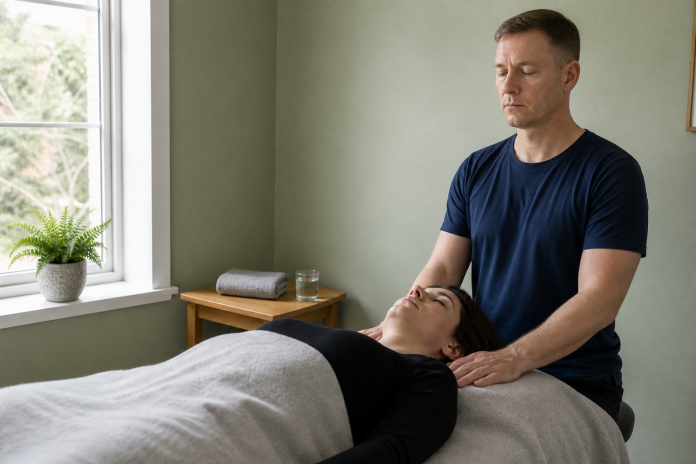
- 2. SettleYou lie fully clothed on a massage table or sit in a chair. Shoes off. Lights normal or dimmed. Quiet music is common.
- 3. HandsThe practitioner holds a series of positions, resting lightly or hovering. Each lasts a few minutes. You may feel warmth from their hands, or nothing at all.
- 4. CloseA few minutes to come round, a glass of water, and a brief debrief. You should feel free to ask what they noticed and what they mean by it.
What the research shows
| Claim | What the evidence says |
|---|---|
| There is an energy field around the body that practitioners work with. | None has been detected. The US National Center for Complementary and Integrative Health states there is no scientific evidence for the field thought to play a role in Reiki. |
| Trained practitioners can feel the field. | In the best-known test, published in JAMA in 1998, 21 Therapeutic Touch practitioners tried to sense which of their hands a hidden experimenter’s hand was near. They were right 44% of the time; chance is 50%. |
| Reiki relieves pain, anxiety and depression. | Studied, but most trials are small and poorly controlled and the results are inconsistent. NCCIH’s summary: not clearly shown to be effective for any health purpose. |
| Energy healing is dangerous. | No harmful effects have been found from the sessions themselves. The risk is indirect: delaying or replacing effective treatment. |
| People feel more relaxed afterwards. | Consistently reported and probably real. It is also what happens after thirty quiet minutes of rest with a calm person paying attention to you. |
| Bad feelings afterwards are a “healing crisis” or “detox”. | No basis. Feeling worse after a session is information to take to a doctor, not proof the treatment is working. |
Sources for the table: the NCCIH page on Reiki and the 1998 study A close look at Therapeutic Touch, designed by a nine-year-old, Emily Rosa, for a school science fair.
Why people feel better anyway
Dismissing the mechanism does not dismiss the experience. Several ordinary things happen in a session, and each has evidence of its own.
Key takeaways
- Rest with nothing asked of you. Thirty to sixty minutes lying still with the phone off lowers heart rate and muscle tension on its own; it is the same relaxation response that meditation and slow breathing produce.
- Attention. Someone calm is focused entirely on you and asking how you are. That is rarer than it should be and it changes how people feel.
- Touch. Slow, light touch on the skin activates nerve fibres tied to comfort and social bonding. See Healing Through Touch.
- Expectation. Expecting to feel better produces measurable changes in reported pain and mood. This is not fakery; it is a real effect that any pleasant, hopeful setting can trigger.
- The frame. For some people, thinking of their tiredness or grief as “energy that can move” is easier than naming it. That is a useful metaphor as long as it stays one. See what “vibration” really describes.
After a session: what is normal and what is not
- Feeling sleepy, floaty or unusually calm for a few hours.
- Feeling emotional, teary or unexpectedly moved. Quiet attention brings things up.
- Feeling thirsty or hungry.
- A brief light-headedness on standing, which passes in a minute.
- New or worsening pain, numbness, dizziness that persists, or any symptom you came in with getting worse. See your GP; do not accept “that’s the healing crisis”.
- Being told to skip a dose, delay a test or cancel an appointment because the healing “needs space to work”.
- Being told your problem is a curse, an attachment or an entity that requires paid removal. That is a known scam pattern; the FTC explains what to do if you were scammed.
Choosing a practitioner
Good signs
- Describes the work as relaxation and support, not treatment or cure.
- Asks about your medical care and encourages you to keep it.
- States price and length up front; no packages you must buy today.
- Explains what they will do with their hands and asks consent for touch.
- Stops when you ask, without argument.
Walk away if they
- Diagnose an illness or tell you a scan or blood test is wrong.
- Claim to treat cancer, infertility, long COVID, autism or “vaccine injury”.
- Advise stopping or reducing prescribed medication.
- Sell “quantum”, “matrix” or “light” healing with supplement or diet plans attached.
- Charge premium prices for distance healing with results only they can see.
Doing it for yourself
You do not need a practitioner to get most of what a session gives. A hands-on self-soothing routine is in Use Your Hands to Recharge; a body-based routine built on the chakra map is in Balancing the Chakras; and the quickest way back to steady when you are overwhelmed is in Grounding Yourself. If you give readings or sessions to others, looking after your own health as a practitioner matters more than any protection ritual.
Frequently asked questions
1. What is energy healing?
A group of practices, including Reiki, Therapeutic Touch, Healing Touch, qigong healing and pranic healing, in which a practitioner uses their hands on or near a clothed person with the intention of balancing or directing a subtle life force. Sessions are quiet and gentle.
2. Is energy healing the same as Reiki?
Reiki is the best-known form of it. Energy healing is the umbrella; Reiki, Therapeutic Touch, Healing Touch, qigong and pranic healing are specific traditions under it, each with its own training and hand technique.
3. Does energy healing work?
As relaxation, often yes: people reliably report feeling calmer afterwards. As treatment for any condition, it has not been shown to work. The US NCCIH summarises Reiki as not clearly effective for any health-related purpose, with mostly low-quality, inconsistent studies.
4. Is there scientific evidence for an energy field around the body?
No. The body produces measurable heat and tiny electrical and magnetic signals from the heart and brain, but nothing matching the field that energy healing describes has been detected, and practitioners tested blind could not sense one.
5. Why did I feel so relaxed if nothing was transferred?
Because a lot was happening: half an hour of stillness, a calm person’s full attention, light touch, quiet, and the expectation of feeling better. Each of those lowers stress on its own. Together they are a strong dose of relaxation, whatever label is on the door.
6. Is energy healing safe?
The sessions themselves have not been shown to cause harm. The danger is indirect: using it instead of medical care, or being talked out of medication or tests. Keep your doctor and use energy healing alongside.
7. Can energy healing replace medical treatment?
No. Nothing in the research supports that, and any practitioner who suggests it is acting outside what the evidence and most professional codes allow. It can sit comfortably beside treatment as a form of rest and support.
8. What should I wear and expect at a first session?
Comfortable clothes; you stay dressed and only remove shoes. Expect a short conversation, then 30–60 minutes lying on a table or sitting while the practitioner holds hand positions. Ask beforehand whether they touch or hover, and say which you prefer.
9. How long is a session and what does it cost?
Typically 30 to 60 minutes. Prices vary widely by country and city and often sit in the range of a massage. Be wary of high-priced packages or anything sold as a course of treatment you must complete.
10. What is a “healing crisis”? Is it real?
It is a term used to reframe feeling worse after a treatment as a sign it is working. There is no evidence for it in energy healing. If you feel worse in a way that persists, treat it as a symptom and see a doctor.
11. I felt tired and emotional afterwards. Is that normal?
Yes, and common. Deep rest and quiet attention bring feelings up, and people often sleep hard that night. It should pass within a day. Persisting or worsening symptoms are a different matter and belong with your GP.
12. Can energy healing be done at a distance?
Many practitioners offer it. There is no evidence it does anything beyond the comfort of knowing someone is thinking of you, which is real but does not justify high prices. Treat expensive distance healing as a red flag.
13. What are the warning signs of a dishonest practitioner?
Diagnosing illness, claiming to treat serious conditions, advising you off medication, selling curse or “attachment” removal, pressure to buy packages, and secrecy about what they are doing. Any one of these is enough to leave.
14. Can I learn Reiki myself, and what is an attunement?
Yes; Reiki is taught in levels, and the first can be done in a weekend. An attunement is a short ritual the teacher performs that is said to open the student to the energy. Treat it as an initiation into a practice, not as a measurable change in you.
15. Do hospitals offer Reiki?
Some do, usually through volunteer or integrative-care programmes, as comfort for patients who want it. Availability in a hospital does not mean it has been proven; it means it is safe and some patients find it soothing.
16. What was the Emily Rosa experiment?
In 1996–97, nine-year-old Emily Rosa asked 21 Therapeutic Touch practitioners to sit behind a screen and say which of their hands her hand was near. Across 280 trials they were right 44% of the time, worse than a coin toss. It was published in JAMA in 1998.
17. Does energy healing help anxiety or depression?
Small studies report reduced anxiety scores after sessions, consistent with relaxation, but the trials are weak and the effect is not distinguishable from resting with a kind person. For ongoing anxiety or low mood, talking therapy and a GP visit have far stronger evidence.
18. Is it compatible with my religion?
That is between you and your tradition. Reiki is not a religion and does not require belief, though it has Buddhist and Shinto roots; some churches object to it, others host it. Faith healing within a religious frame is a separate practice.
19. How often should I go?
As often as it is worth the money to you for the rest it gives, which for most people is occasionally. There is no evidence that a course of sessions builds a cumulative effect, so be sceptical of schedules you are told you must keep.
20. What does “energy” mean if it cannot be measured?
In this context it is a metaphor for how you feel: drained, heavy, restless, light. That is a useful shorthand for real states of the body and mind, and the honest way to use the word. It is not the energy physics measures.
Evidence note: this article describes energy healing as its practitioners understand it and reports what controlled research has found, including the absence of a detectable field and the weak, inconsistent results for health outcomes. Sessions are safe as rest; they are not treatment. Anyone with a medical condition should keep their usual care, and anyone told to pay for curse or attachment removal should treat it as a scam.
I appreciate the balanced perspective given here, detailing both the benefits and potential side effects of energy healing. It helps set realistic expectations.
This article provides an interesting overview of what to expect from energy healing, and it seems to cover both positive and negative experiences quite comprehensively.
The emphasis on self-care practices like journaling and meditation to counteract negative side effects is practical and useful for anyone considering energy healing.
The mention of matrix balancing and its historical roots adds depth to the discussion. It’s intriguing to see modern applications of ancient practices.
The list of potential benefits from energy healing is extensive. I wonder how one would measure the efficacy of such treatments over time.