


Quick guide
Being told to “just move on” after a breakup, a betrayal, a lost job or a death is useless advice, because moving on is not a decision; it is a process, and the process needs a marker. That is what closure rituals are for. Writing a letter and burning it, cutting an imagined cord, releasing something into water, building and then dismantling a small altar: these are old, cross-cultural ways of telling your body and mind that a chapter has ended. They work, and the reason is not that energy has been cleared. Controlled research finds that rituals reduce grief by restoring a sense of control, and they do so whether or not the person believes in them. Below: the rituals, what each is good for, the evidence, safety notes the old version lacked, and a five-step template for designing your own.
Why a ritual helps when “moving on” does not
After an ending, the mind replays the last conversation, the body stays braced, and the situation stays open because nothing has marked it as closed. Rituals close it. In a series of experiments published in the Journal of Experimental Psychology: General, Michael Norton and Francesca Gino found that people who performed a ritual after a loss (a bereavement, a breakup, even a lost lottery) reported less grief than people who did not, and that the effect came from a restored sense of control rather than from any belief in the ritual’s power. The paper is Rituals Alleviate Grieving for Loved Ones, Lovers, and Lotteries. That finding is the honest foundation for everything below. “Energetic closure” is a metaphor for it; you can keep the metaphor if it helps, and the ritual will work either way.
The rituals, what each is good for, and what to watch
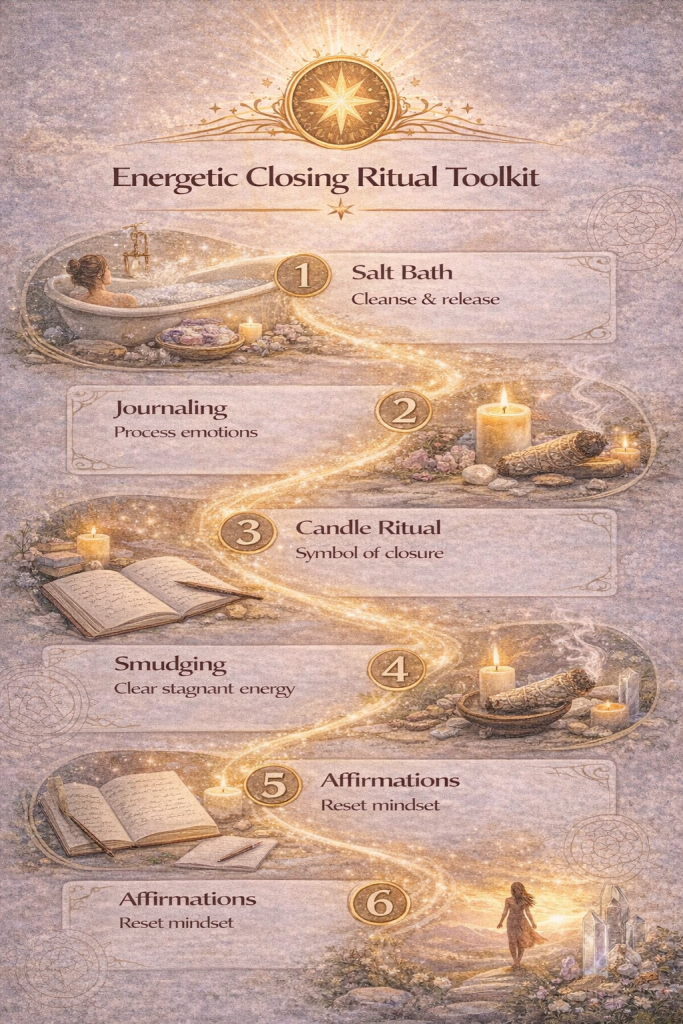
| Ritual | How | Best for | What it does | Watch |
|---|---|---|---|---|
| Letter you never send | Write everything unsaid: anger, grief, love, the last word. Then burn it in a metal bowl outdoors, tear it up, or seal it in an envelope and put it away. | Breakups, betrayals, unfinished conversations with the dead | Gets the loop out of your head and onto paper; the burning marks it finished. | Fire outdoors, in a metal container, with water beside you. Never in a bedroom or near curtains. |
| Cord-cutting visualisation | Sit quietly, picture a cord between you and the person, and cut it with scissors or a blade in your mind. Say what you are cutting: “the habit of checking her page”, not just “the cord”. | Obsessive thinking about an ex or a former friend | A vivid image of a decision. Repeated nightly, it becomes a cue to stop the replay. | Do not call on anyone or anything to do it for you; the point is that you did it. Repeat it whenever the thought returns. |
| Water release | Write the words on paper and let a river or the sea take it (use plain paper that will break down, not plastic-coated); or a long bath at the end of the last hard day. | Leaving a job, a house, a role | Water is the universal symbol of washing off; the walk to the water is part of it. | No candles floating on water, no glass. Take only paper that dissolves. |
| Closure altar | A shelf with a photo, an object, flowers. Sit with it a few minutes a day until it feels finished, then take it down deliberately. | Bereavement, the end of a long marriage | Gives grief a place, so it is not everywhere. Taking it down marks the shift from mourning to remembering. | Set an end date in advance (a month, a season). An altar with no end becomes a shrine to being stuck. |
| Boxing and burying | Photos and keepsakes into a box; store it, give it away, or bury it in the garden. | A friendship that ended, a former self | Physically moves the past out of daily sight without destroying it. | Do not burn or bin things you may want in ten years. Storage is closure too. |
| Movement and sound | A long walk, a hard run, a drumming circle, loud singing in the car, shouting into a pillow. | Anger that has nowhere to go | Discharges the braced body. A 2025 scoping review in JMIR Mental Health found sound and music interventions reduce physiological stress markers. | Not a substitute for saying the thing to the person, if the thing needs saying. |
| Thirty nights of a candle | Light a candle at the same time each evening, say one sentence about what is ending, blow it out. | Divorce, a long illness’s end, a move | Repetition builds the new normal; the daily sentence changes over the month, which is the healing. | Blow it out before you leave the room. Battery candles work identically. |
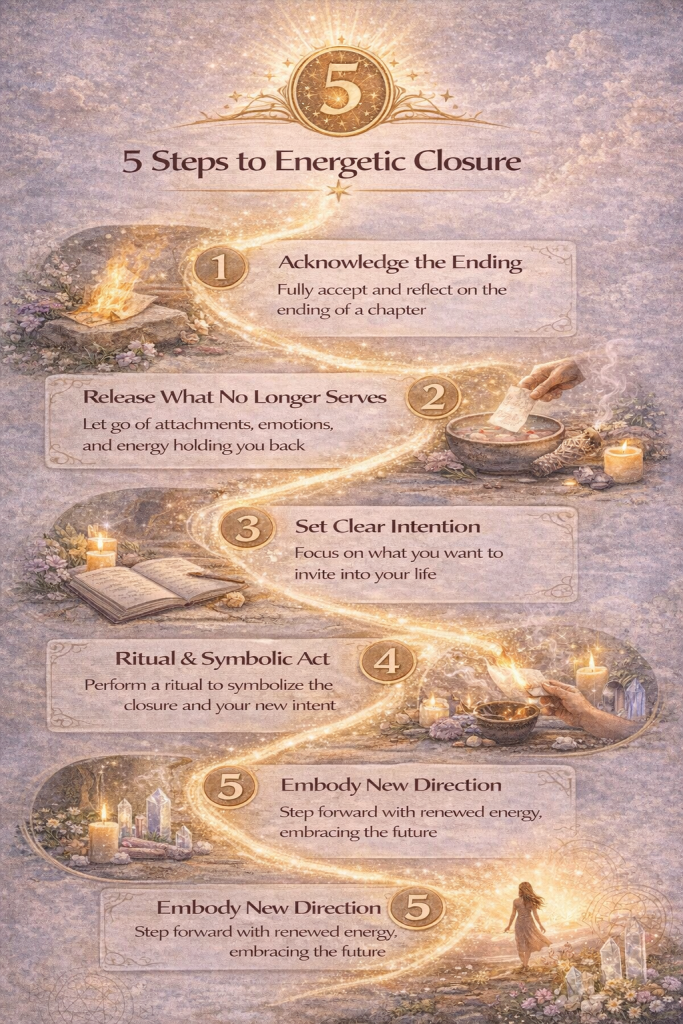
Designing your own: five steps
- 1. Name itSay exactly what is ending, in one sentence. “My marriage” is too big; “the hope that he’ll change” is a ritual’s worth.
- 2. Choose the actFire to finish, water to wash, earth to bury, breath and movement to discharge. Pick one; do not stack them.
- 3. Say it out loudA ritual with no words is a chore. One sentence, spoken, is enough: “I’m done waiting.”
- 4. Do it once, fullyThen stop. A ritual repeated to feel the relief again becomes a way of not moving on. Daily rituals need an end date.
The fifth step is what comes after: ground yourself, eat, sleep, tell one person you did it. See Grounding Yourself for the two-minute version.
What rituals cannot do
- Replace the conversation that still needs to happen. If the person is alive and safe to talk to, a ritual is what you do after you have said your piece, or once you have decided not to.
- Clear an “aura”, “remove karmic ties” or cut a bond from a past life. The old version of this article made those claims. Nothing has been measured; what changes is you, and that is the whole point.
- Fix grief that has stopped moving. If a year on the pain is as sharp as the first month and daily life has not resumed, that is a recognised condition with effective treatment. The National Institute on Aging’s guide to coping with grief and loss says when to seek help.
- Make an unsafe ending safe. If the person you are leaving frightens or controls you, the ritual comes after the safety plan. In the US, the National Domestic Violence Hotline is 1-800-799-7233, or text START to 88788.
Where a reader or healer fits
Some people like a witness. A reader, a celebrant, a minister or a friend can hold the space while you do the ritual, and a structured tarot spread can be a good way to name what is ending; see 13 Beginner Tarot Spreads. What no practitioner can do is perform your closure for you or cut cords on your behalf, and anyone who charges to remove a tie, an attachment or a curse is selling the fear. The ritual is yours; the witness is optional.
Illustrations
The following are composites drawn from common experiences, not case records of named people.
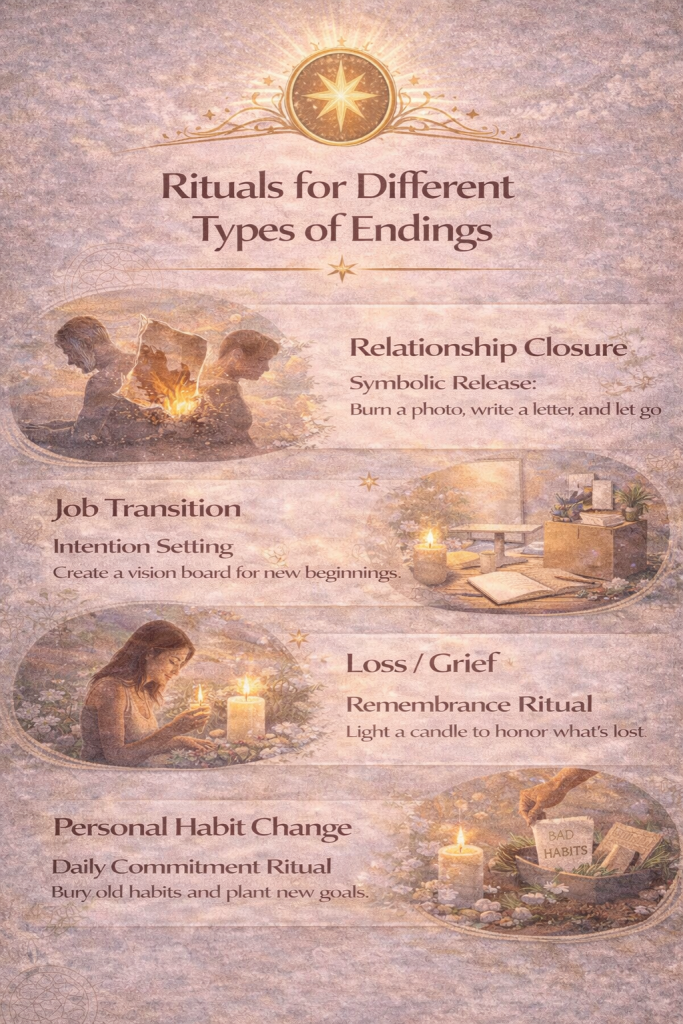
- A woman a year past a divorce lit a candle every evening for thirty nights and said one sentence about what she was letting go. The sentences changed from “I hate that he lied” to “I want my evenings back”. By the end she had them.
- A father who lost his son wrote him letters and burned them at the grave. He does not claim it brought his son back in dreams; he says it gave him somewhere to put the words.
- A man leaving a bullying workplace wrote every unfair thing on paper and let a river take it. He started the new job without the old boss in his head.
- A woman ending a friendship put the photographs in a box and stored it in the loft. She has not opened it. She also has not needed to.
Key takeaways
- Rituals reduce grief by restoring control, and they work whether or not you believe in them.
- Name the specific thing ending; choose one act; say one sentence; do it once, fully.
- Fire outdoors in metal; no candles near water or fabric; paper that dissolves, not plastic.
- Daily rituals need an end date, or they become a way of staying.
- A ritual follows the conversation and the safety plan; it does not replace either.
Related reading
- Saying Goodbye and Moving On: the goodbye conversation, scripted.
- Forgiving Yourself and Others: when the ending needs forgiveness first.
- What Happens When You Block Someone: the digital ending.
- Connecting with Loved Ones After Death: when the ending is a death and the bond continues.
- Divorce and Breakups: the first ninety days.
Frequently asked questions
1. Do closure rituals really work?
Yes, in controlled experiments. Performing a ritual after a loss reduced reported grief, and the effect came from a restored sense of control rather than belief in the ritual. It works for sceptics.
2. What is “energetic closure”?
A spiritual name for the same process: marking an ending so the mind and body stop treating it as open. Nothing measurable is cleared; what changes is your sense that it is finished, which is what you needed.
3. Which ritual should I choose?
Match the act to the ending: a letter for unsaid words, cord-cutting for obsessive thoughts, water for leaving a place or role, an altar for a death, movement for anger. Choose one. Stacking rituals dilutes them.
4. Is cord-cutting real?
The cord is an image; the cutting is a decision made vivid. It helps with intrusive thoughts about a person because it gives you a clear mental act to repeat when the thought returns. No cord exists to be cut.
5. Is it safe to burn a letter?
Outdoors, in a metal bowl or fire pit, with water beside you, away from anything that can catch. Never indoors, never in a bathroom, never leave it. Tearing it up or sealing it away works the same.
6. How many times should I do a ritual?
A marking ritual (letter, water, box) once. A daily ritual (candle, altar) for a set period you decide in advance, then stop. Repeating a ritual to feel the relief again turns it into a way of staying attached.
7. I did the ritual and still feel bad. Did it fail?
No. A ritual marks the end; it does not erase the grief that follows an ending. Feeling sad after is normal. Feeling exactly as stuck weeks later means the thing that needed saying or deciding has not been said or decided.
8. Can I do a ritual for someone who is still alive?
Yes; most breakup rituals are. Do it after you have said what needs saying to them, or after you have decided not to. A ritual should not be a way of avoiding a conversation you could safely have.
9. Do I need a psychic or healer?
No. A witness can help, and some people like a reader or celebrant to hold the space. Nobody can do the closure for you, and anyone charging to cut cords or remove attachments on your behalf is selling fear.
10. Are salt baths cleansing?
A bath is relaxing and can be a fine end to the last hard day. Salt cleanses skin, not energy. Keep candles out of the bathroom.
11. What about full moons and timing?
A date you choose in advance makes a ritual feel more deliberate, and a full moon is as good a date as any. It adds meaning, not power.
12. Can a ritual help with grief after a death?
Yes, and funerals, memorials and anniversaries are exactly this. An altar with an end date, letters, and a yearly ritual all help. If grief has not moved after a year, seek help; that is treatable.
13. My ex keeps coming back into my head. Which ritual?
Cord-cutting, nightly, with a specific sentence about what you are cutting, plus practical steps: unfollow, remove photos from your phone’s daily view, change the route past their street.
14. Is it childish to bury a box in the garden?
Humans have buried significant objects for at least a hundred thousand years. It is one of the oldest things we do. It is not childish; it is human.
15. Can I make up my own ritual?
Yes, and homemade rituals often work best because every element means something to you. Follow the five steps: name it, choose the act, say it out loud, do it once fully, ground afterwards.
16. What if the ending was not my choice?
Rituals help most when control was taken from you, because they give a piece of it back. Being left, fired or bereaved are the endings the research was done on.
17. Should I involve the other person?
Sometimes, for a divorce or a shared loss, a joint ritual is a gift to both. Never for someone who frightens or controls you; then the ritual is private and comes after the safety plan.
18. Can children do closure rituals?
Yes, and they take to them naturally: a drawing burned or buried, a goodbye letter to a pet, a balloon released (biodegradable, please). Keep fire in adult hands.
19. Is there a ritual for forgiving myself?
Writing the letter to yourself, reading it aloud, and then burning or sealing it is the classic form. See Forgiving Yourself and Others.
20. What is the single most effective element?
Saying the sentence out loud. Research on rituals finds the physical act matters, but the spoken intention is what most people remember afterwards, and it is what turns an action into an ending.
Evidence note: this article presents closure rituals as psychological practices with experimental support and treats “energy”, “aura” and “karmic ties” as metaphors. Claims about clearing energy fields, calling on archangels, or removing past-life bonds have been removed, as have links carrying tracking parameters. The stories in this article are composites, not case records. If an ending involves fear or control, safety comes before ritual: 1-800-799-7233, or text START to 88788 (US). For grief that has stopped moving, see a doctor.
“Cutting cords? Sounds like something from a bad sci-fi movie! Can’t wait for the sequel where someone becomes an energy healer with laser scissors! 😂”
While the concept of energy closure sounds nice, it feels like a bunch of fluff to me. Can we really trust psychics and their rituals? Just seems like a way to profit off people’s pain without any real substance.
I can’t help but laugh at how people might take this too seriously! Imagine doing the water ritual in public—what will folks think when you start dissolving paper by the river? 😂🌊
“Burning letters? That’s brilliant! I’m definitely trying that as a way to deal with my breakup feelings! This article has inspired me to take control of my emotions in a fun way! 🔥✉️”
While I appreciate the effort put into discussing these concepts, let’s not forget that some individuals may need professional help beyond rituals and spiritual practices for serious issues.
“The scientific backing behind these rituals is compelling. It’s interesting how psychology intersects with spiritual practices. I think it’s essential we don’t dismiss these methods outright without exploring their potential benefits.”
“Letting go” is easier said than done. This article makes it sound so simple when, in reality, it’s one of the hardest things to do after heartbreak or loss. Just writing letters won’t magically fix everything!
This whole idea seems so over-the-top sometimes, but hey, if dancing around your living room helps you feel better about life, who am I to judge? Go get your groove on!
I found this article fascinating! It offers a unique perspective on grief and healing through rituals. The connection between psychology and spirituality really opens up new avenues for emotional recovery. I’m eager to try some of these techniques myself.
I see your point, but I think rituals can complement traditional methods. Healing isn’t one-size-fits-all; combining various approaches might be more beneficial for many people.
But isn’t it just an excuse to avoid facing your problems directly? Rituals may feel good temporarily, but they can’t replace actual healing and therapy.
This article is incredibly insightful! The idea of energy closure really resonates with me. I appreciate how it emphasizes the importance of rituals in the healing process. I believe everyone should consider these practices for emotional wellness! 😊