

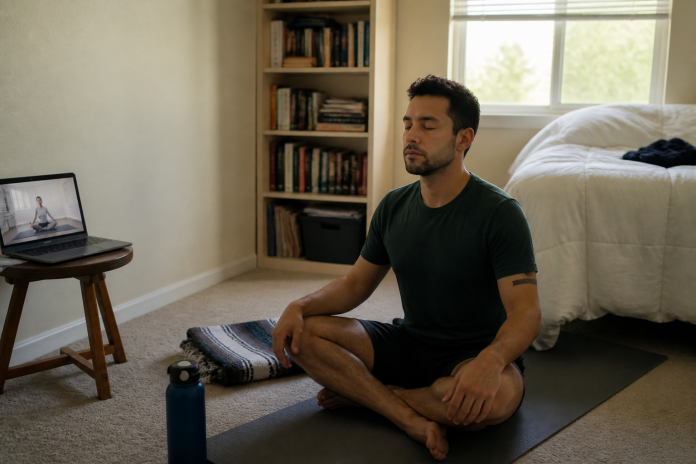
Quick guide
“Balancing the chakras” is a way of giving seven areas of your body and life a few minutes of attention each: your footing, your hips and pleasure, your gut and confidence, your chest and feelings, your throat and voice, your eyes and focus, and the top of your head and sense of meaning. Chakras themselves are a map from Indian yoga traditions, not organs, and nothing about them can be measured or unblocked. What the practice offers is a fifteen-minute routine of breathing, gentle movement and honest check-in that many people find steadying. This guide gives that routine, the history, what research supports, and the health claims to leave behind.
Where the chakra map comes from
The word chakra is Sanskrit for wheel. Centres of subtle energy along the spine are described in Hindu and Buddhist tantric texts from roughly the 8th century onward, with different traditions counting four, five, six or seven of them. The seven-chakra scheme with a rainbow of colours is largely a 20th-century Western arrangement; the Encyclopaedia Britannica’s entry on chakras gives the background. None of this makes the practice pointless. It means “blocked” and “open” are metaphors inside a contemplative system, and a good routine treats them that way.
The 15-minute routine
- 1. Settle (2 min)Sit or stand with feet flat. Six slow breaths, out-breath longer than in-breath.
- 2. Move (7 min)One minute at each of the seven centres: the body-based practice from the table below.
- 3. Check in (4 min)Score each area 1 to 5 in a notebook. Which is lowest this week?
- 4. Act (2 min)Write one small, dated action for the lowest area. That is the “balancing”.
Do it three mornings a week for a month before judging it. The notebook is where you will see what it does for you.
The seven centres: a practice for each
| Centre (traditional) | Life area it stands for | One-minute practice | Check-in question |
|---|---|---|---|
| Root, base of spine (Muladhara) | Safety: home, money, health, footing | Stand, press both feet into the floor, sway gently and find the point where you feel most steady | Do I feel safe enough this week? What one thing would make me safer? |
| Sacral, lower belly (Svadhisthana) | Pleasure, creativity, closeness | Slow hip circles, both directions, hands on hips | What did I enjoy this week for its own sake? |
| Solar plexus, upper belly (Manipura) | Confidence, will, decisions | Belly breathing: hand on stomach, let it rise on the in-breath, six rounds | What decision am I putting off? |
| Heart, centre of chest (Anahata) | Connection, feelings, boundaries | Clasp hands behind the back, open the chest, three slow breaths | Who did I feel close to this week, and who drained me? |
| Throat (Vishuddha) | Honesty, being heard | Hum on the out-breath for six breaths; feel it in the neck | What have I not said that needs saying? |
| Brow, between the eyebrows (Ajna) | Attention, judgement, seeing clearly | Palms over closed eyes for thirty seconds, then look at something far away | What do I already know about this situation that I am avoiding? |
| Crown, top of head (Sahasrara) | Meaning, wonder, belonging to something larger | Sit quietly with a straight spine and do nothing for a minute | What is bigger than my to-do list this week? |
What the research supports
Reasonable evidence
Yoga, the practice the chakra map grew up in, has evidence for flexibility, balance, back pain and stress; the National Center for Complementary and Integrative Health summarises it in its yoga fact sheet. Meditation and slow breathing have modest, real effects on stress and attention with regular practice; see NCCIH on meditation and mindfulness. A regular check-in that ends in one action is the part of this routine that changes lives, because it is the part that changes anything.
No evidence
That a blocked solar plexus causes indigestion. That an orange visualisation, a carnelian crystal or eleven minutes with a stone on your belly changes anything physical. That essential oils balance the throat. That a chakra can be measured, opened by a practitioner, or diagnosed as blocked. The older version of this page made several of these claims; we have removed them.
When “blocked” is a symptom
Lists of blocked-chakra signs often include things that are medical: persistent indigestion, chronic low mood, anxiety about the future, difficulty breathing. Feeling shy or stuck is a fair prompt for reflection. Two weeks of stomach trouble, sadness most days, panic, or shortness of breath is a doctor’s question, and no amount of belly breathing substitutes for the appointment. The National Institute of Mental Health’s guide to caring for your mental health covers when to seek help; in the US, call or text 988 if you feel unsafe.
Making it your own
- Outdoors helps. Daylight and a change of scene improve mood more reliably than any visualisation; do the routine in the garden or the park when you can.
- Crystals, colours and oils are optional decoration. If a stone in your hand helps you sit still, keep it. Do not pay much, and do not put crystals in water you drink.
- Skip the cord-cutting and sage if they don’t speak to you. They are rituals that mark a change of state; a cup of tea does the same.
- Do not use it instead of care. Alongside treatment, fine. Instead of it, never.
Key takeaways
- Chakras are a contemplative map, not organs; the rainbow version is modern.
- Balancing them, honestly done, is a fifteen-minute routine of breath, gentle movement and a written check-in that ends in one action.
- Yoga, meditation and slow breathing have real but modest evidence; crystals, colours and oils do not.
- Persistent physical or mood symptoms belong with a doctor, whatever a chakra list says.
Related reading on this site
- Signs your chakras are out of balance: a self-check, not a diagnosis
- The solar plexus: confidence, decisions and the gut
- Eating by chakra colour: what is real in it
- Chakras and aura: keeping the practice honest
- Raising your vibration: what the phrase really means
- Grounding yourself: a two-minute method
Frequently asked questions
1. What does balancing the chakras mean?
Giving seven areas of body and life some attention: safety, pleasure, confidence, connection, voice, focus and meaning. In practice, a short routine of breathing, movement and a written check-in.
2. Are chakras real?
They are a real concept in Indian contemplative traditions and a useful map. They are not physical structures and cannot be detected or measured.
3. How do I know which chakra is blocked?
Translate it: which area of your life feels neglected or stuck this week? Score all seven from 1 to 5 and take the lowest.
4. How long does the routine take?
About fifteen minutes. Three times a week is enough to notice a difference within a month.
5. Do I need crystals?
No. A crystal can be a pleasant focus object; it does nothing measurable. A pebble works the same.
6. Do the colours matter?
The rainbow assignment is a 20th-century addition. Visualising any colour works as a focus exercise; the specific colour has no effect.
7. Can a blocked chakra cause indigestion?
No. Indigestion has physical causes. Belly breathing can ease tension, and a doctor can check anything that persists.
8. Is chakra balancing the same as yoga?
Chakras come from the same tradition. Yoga has evidence for flexibility, balance and stress; the chakra routine borrows its breathing and some of its movement.
9. Can someone else balance my chakras for me?
A reiki or “chakra balancing” session can be relaxing, which is worth something. Nobody can detect or adjust a chakra, and a practitioner who says yours are blocked is reading your conversation.
10. What is the crown chakra for?
Meaning and connection to something larger. In practice: time in nature, community, art or a practice bigger than your to-do list.
11. Is it religious?
It comes from Hindu and Buddhist traditions and can be practised devotionally. The routine here works with or without belief.
12. Can I do it lying down?
Yes, except the root practice, which is easiest standing. Lying down makes the check-in more likely to become a nap, which is also fine.
13. Are there risks?
The practices are gentle. The risk is in the framing: treating a symptom as an energy problem, or paying someone to fix a blockage they diagnosed.
14. What if all seven areas score low?
That points to exhaustion or low mood rather than seven problems. Start with sleep and a GP conversation.
15. Do essential oils help the throat chakra?
Lavender smells nice and can be relaxing. Nothing about it affects a chakra or your honesty. Never take essential oils by mouth.
16. What about cord-cutting and sage?
Rituals that mark a change of state. Use them if you like them; they are not necessary and smoke is not for asthmatics.
17. Can chakra work open psychic abilities?
The brow practices are attention exercises. No practice has produced psychic ability under controlled conditions.
18. How is this different from a normal wellbeing check-in?
It is a wellbeing check-in with seven memorable headings and a minute of movement for each. The map is the mnemonic.
19. Should children do it?
The breathing and movement are fine for anyone. Skip the metaphysics; “how do you feel in your tummy today?” is the whole thing.
20. What should I do first?
Sit down, six slow breaths, score the seven areas, pick the lowest, write one action. Fifteen minutes.
Evidence note: Chakras, energy and blockages are used on this page as a reflective framework, not as measurable facts. Health information links to the NCCIH and NIMH; nothing here replaces medical advice.
The detailed description of each chakra and its corresponding meditation practices is quite enlightening. It’s intriguing to see how ancient practices can still be relevant in modern times.
It’s interesting to learn about the various types of meditation and visualization techniques associated with each chakra. This article offers a holistic approach to maintaining mental and physical well-being.
The article makes a compelling case for the benefits of chakra meditation. The step-by-step instructions for different chakras are practical and easy to follow.
The explanation of how chakras operate as energy gatekeepers is a fascinating concept. It provides a comprehensive guide for anyone interested in exploring these practices further.
The connection between chakras and physical as well as emotional well-being is well-articulated. The practical tips for balancing each chakra make it accessible for beginners.