

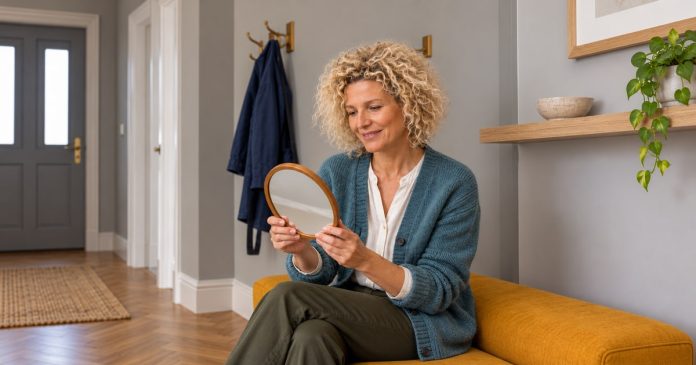
MIRROR SYMBOLISM / MEANING, CHOICE AND PRACTICAL CARE
If a mirror feels meaningful as a symbol of protection, you can use it in a simple, freely chosen practice. You do not need to send harm back to anyone, buy a special object or get every detail “right” to deserve peace.
A mirror’s reflection does not tell you who means you harm or establish that an attack has happened. Treat a protective interpretation as spiritual meaning, not a promise that the object will control another person’s behaviour. Pair any ritual you enjoy with appropriate attention to the situation itself.
On this page
For a wider discussion of boundaries, optional spiritual practices and pressure in protection offers, see Protecting Yourself from Psychic Attacks. Here, the focus is the mirror itself: its meaning, a gentle way to use it and the ordinary safety checks that still matter.
Three ways to understand mirror symbolism
Mirrors have appeared in different spiritual settings. That does not make every reflective object part of one tradition, or every use a version of the same ritual. A historical object can document a belief without proving that the belief’s promised effects occur.
1. Chinese mirror and Bagua symbolism
The National Palace Museum’s discussion of Taoist objects describes bronze mirrors as objects once thought to reveal spirits and offer protection. It also explains the Bagua, or Eight Trigrams, as symbols used on ceremonial objects.
This gives cultural context, not a universal instruction to put an ordinary mirror above a door. Do not treat a personal reflection exercise as a complete feng shui method or assume that all Chinese households share the same practice.
2. A historical mirror with an inscription
The British Museum records a twelfth-century bronze mirror made in Iran with an Arabic inscription described as a magic formula added to its back. This is a specific object with a specific history.
It is not a reason to assign one belief to every person in a region or faith, or to treat all mirrored charms and textiles as interchangeable. You can appreciate an object’s history without copying a practice you do not understand.
3. Your own freely chosen reminder
You might use an ordinary mirror to represent a boundary, a fresh start or a moment of self-respect. That is a personal use you choose, rather than a claim to reproduce a particular cultural ceremony.
A helpful intention could be, “I will pause before accepting another request,” or “I can leave this conversation when I need to.” You can use words, a notebook or another familiar object instead. The mirror is optional.
What to ask of a mirror practice—and what not to ask
Let the mirror stand for something within your choices: noticing a limit, remembering a request you want to make or taking a comfortable pause. You may find that meaningful, or you may find the object distracting. There is no guaranteed emotional benefit and no need to keep using it if it increases worry.
Do not use the reflection as evidence of a curse, a person’s intentions or a problem with your spiritual worth. Likewise, do not rely on an arrangement of mirrors to stop harassment, repair a relationship, settle a workplace problem or make a home safe. Those concerns deserve appropriate action and support.
If a mirror exercise leads you to focus on colours or outlines, How to View Auras separates personal interpretations from possible visual effects and explains when vision changes need care. Do not force yourself to stare or produce an unusual experience.
A five-step personal practice without flame or pressure
This is an optional reflection exercise, not a required protection procedure. Use a comfortable, ordinary setting. You can skip any spoken words, stop partway through or use no mirror at all.
- Name one intention. Choose a sentence about your own next step: “I will ask for time before agreeing,” rather than “this will change my colleague.” You do not have to identify a person as a source of harmful energy.
- Choose a simple, safe object. If you use a mirror, choose an undamaged one that you can hold comfortably or place on its intended stable stand. No bath, salt, candle, incense or purchase is necessary.
- Take a brief, comfortable pause. Say or silently read your sentence if you wish. Blink and look away normally. You do not have to see a sign, feel a shift or repeat words a set number of times.
- Choose whether to display or put it away. A reminder is useful only if you want it there. Follow the safety checks below, keep it out of direct sunlight and do not improvise a window attachment or insecure hanging arrangement.
- Connect the intention to one action. Make a request, consider a limit or seek suitable support if it is safe to do so. Later, ask whether the practice supported your choices. You can change it or stop without a special closing ritual.
An imagined example: a boundary after a demanding workday
Suppose you regularly agree to extra tasks before checking what you can manage. At home, you hold a small mirror briefly and choose the sentence, “I can ask for time to consider a request.”
The next day, if a new task is proposed, the practical step might be to ask about priorities and when an answer is needed. The mirror has not changed your manager’s mood or guaranteed a result. It has served as a symbol for a response you wanted to consider.
Keep the choice with you: if displaying the mirror makes you feel watched, threatened or obliged to check it, put it away. You can retain the intention without the object.
Four practical safety checks before placing a mirror
1. Keep it out of direct sunlight
The London Fire Brigade warns that reflected sunlight can start fires and advises keeping mirrors and other reflective objects out of direct sunlight. Its advice applies throughout the year.
A windowsill is not a suitable default location. Choose a place that remains out of direct sun; if you cannot be confident of that, put the mirror away rather than leaving it on display.
2. Check the glass and support
Do not use broken glass, loose fragments or a damaged frame in a practice. Use the intended stand or follow the manufacturer’s mounting instructions. Keep the object where it cannot readily fall or be knocked over.
Do not glue a mirror to a window, balance it over a doorway or fasten it inside a moving locker door as an improvised ritual step. A written reminder can serve your intention without adding glass.
3. Leave out candles and incense
No flame or smoke is needed for this exercise. The London Fire Brigade’s candle and incense guidance says not to leave them unattended, to put them out before leaving the room or going to bed, and to keep them away from things that can catch fire.
You do not need to let anything burn down to finish a practice. A quiet pause or ordinary room lighting is enough for the optional exercise described here.
4. Respect shared space and other people
Ask before changing a shared room or attaching anything to someone else’s property. Keep any personal object unobtrusive and do not aim a mirror at a neighbour as a statement that they are dangerous.
A dream, reading or uneasy feeling is not evidence that another person has attacked you. Let the practice support your own choices rather than becoming an accusation or a reason to frighten visitors or children.
When you need more than a ritual
Respond to the actual concern
If someone threatens, harasses or controls you, consider appropriate local support and a trusted person’s help. You do not have to confront somebody to demonstrate a boundary, especially if that could put you at risk. Immediate danger calls for local emergency help, not a mirror arrangement.
Feeling uneasy in a room does not identify its cause. If a carbon monoxide alarm sounds or you suspect poisoning, leave for fresh air and seek urgent help. The London Fire Brigade’s carbon monoxide guidance advises leaving immediately, obtaining medical advice when poisoning is suspected and not returning until the source has been addressed by a qualified professional. Follow local emergency guidance; a mirror cannot replace an alarm or a safety assessment.
If the ritual itself leaves you frightened, repeatedly checking or feeling unable to stop, pause it and talk with someone you trust or a qualified professional. You do not have to complete a ceremony before asking for support.
You can value spiritual protection while keeping your practice gentle and your options open. For more on practical boundaries, freely chosen rituals and recognising pressure in protection offers, return to Protecting Yourself from Psychic Attacks. A meaningful object should not take away your freedom to choose what happens next.
I find the ritualistic aspect quite fascinating. The combination of candlelight, incense, and mirrors seems to create a comprehensive sensory experience. It would be interesting to explore the cultural origins of this practice.
The instructions are clear, but I question the scientific basis of these claims. It would be helpful to have some references to studies or historical data that support the effectiveness of this practice.
This article offers a detailed guide on how to use mirrors for protection. However, it might be beneficial to include a section on the psychological underpinning of these practices to provide a more holistic understanding.
That’s a great suggestion. Including psychological explanations could help readers understand the potential placebo effect and how belief systems influence outcomes.
While the methodology is detailed and specific, I am curious about its practical efficacy. Has anyone here actually tried this method and noticed a measurable difference in their environment?
The concept of using mirrors to deflect negative energy is intriguing. It seems to blend psychological and symbolic elements effectively. I wonder if there are any empirical studies that support this practice.